
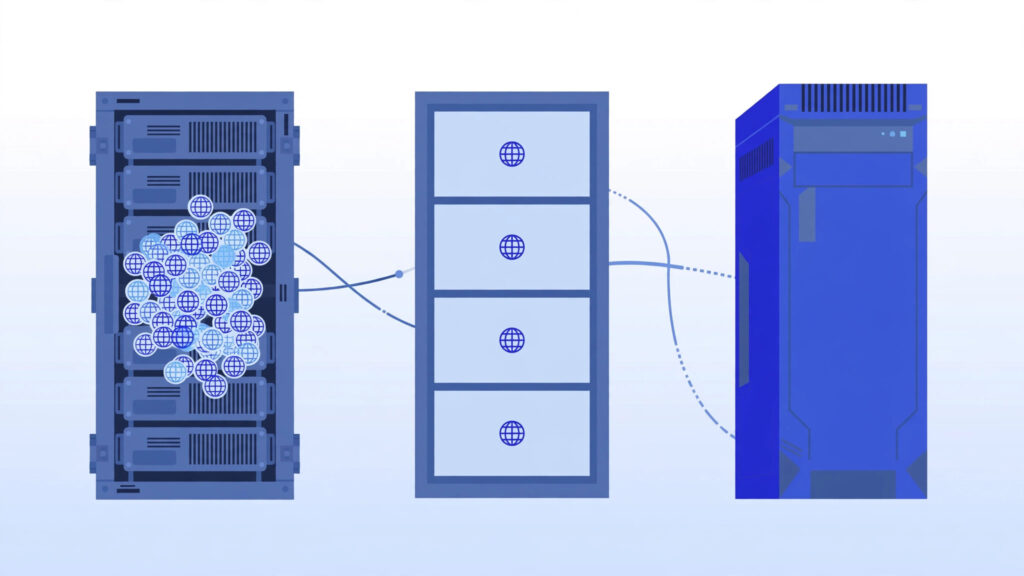
VPS vs shared hosting vs dedicated server — which one do you need? Choosing between these three is one of the first big decisions for any website owner. Pick too little power and your site crawls; pick too much and you burn money every month. This guide breaks down exactly how the three compare — on price, performance, control, and security — so you can pick the right one with confidence.
Disclosure: This post contains affiliate links. If you buy through them, we may earn a commission at no extra cost to you.
Table of Contents
VPS vs Shared Hosting vs Dedicated: Quick Comparison Table
| Feature | Shared Hosting | VPS Hosting | Dedicated Server |
|---|---|---|---|
| Typical price | $2–$10/month | $4–$40/month | $80–$300+/month |
| Resources | Shared with hundreds of sites | Guaranteed slice, isolated | Entire physical server |
| Performance | Variable | Consistent | Maximum |
| Root access | No | Yes | Yes |
| Customization | Very limited | Full | Full |
| Security isolation | Low | High | Highest |
| Scalability | Limited | One-click upgrades | Hardware upgrades |
| Technical skill | Beginner | Beginner–intermediate | Advanced |
| Best for | Small blogs, portfolios | Growing sites, apps, remote desktops | High-traffic sites, enterprises |
Shared Hosting: The Budget Starting Point

With shared hosting, your website lives on a server alongside hundreds (sometimes thousands) of other websites. Everyone draws from the same pool of CPU, RAM, and bandwidth.
Pros:
– Cheapest option — plans often start under $3/month
– Zero server management — the provider handles everything
– Beginner-friendly control panels like cPanel
Cons:
– Noisy neighbors: another site’s traffic spike or malware can slow down or compromise yours
– No root access — you cannot install custom software or change server settings
– Strict resource limits; hosts may throttle or suspend you for using “too much”
– Shared IP address, which can affect email deliverability
Choose shared hosting if: you run a small blog, portfolio, or brochure site with modest traffic and want the simplest, cheapest option.
VPS Hosting: The Sweet Spot

A VPS (Virtual Private Server) carves a physical server into isolated virtual machines using a hypervisor. You get guaranteed CPU, RAM, and storage that nobody else can touch — at a fraction of a dedicated server’s price. New to the concept? Read our guide on what VPS hosting is.
Pros:
– Guaranteed resources with strong isolation from other users
– Full root/admin access — install anything, configure anything
– Better and more consistent performance than shared hosting
– Easy vertical scaling — add RAM or CPU in minutes
– Affordable — entry plans typically start around $4–$6/month as of 2026
Cons:
– You still share the underlying physical hardware
– Unmanaged plans require you to handle updates and security
– Slight learning curve if you are new to servers
Choose VPS hosting if: your site has outgrown shared hosting, you need custom software or a remote desktop, you want consistent performance, or you are a developer who needs a flexible environment. For most growing projects, VPS is the best value.
Dedicated Server: Maximum Power and Control

A dedicated server means you rent the entire physical machine — every CPU core, every gigabyte of RAM, every disk. Nothing is shared with anyone.
Pros:
– All hardware resources are yours alone — maximum performance
– Complete control over hardware and software
– Best isolation and security posture
– Ideal for compliance-heavy workloads
Cons:
– Expensive — typically $80+/month, often much more
– You are responsible for hardware-level decisions and often all management
– Scaling means physical upgrades or migrations, which take time
– Overkill for the vast majority of websites
Choose a dedicated server if: you run a high-traffic application, process sensitive data with strict compliance needs, or consistently max out a large VPS.
VPS vs Shared Hosting: Head-to-Head on the Deciding Factors
Performance
Shared hosting performance is unpredictable — it depends on what your server neighbors are doing. A VPS gives you consistent, guaranteed performance. A dedicated server gives you the absolute ceiling, but most sites never need it. Winner for most people: VPS.
Price
Shared hosting wins on raw price, but the gap has shrunk: a basic VPS now costs little more than premium shared hosting. Dedicated servers are in a different league price-wise. Winner on budget: shared; winner on value: VPS.
Control
Shared hosting gives you almost no control beyond your hosting panel. Both VPS and dedicated servers give you full root access. Winners: VPS and dedicated (tie).
Security
On shared hosting, one compromised neighbor site can be a risk to everyone. VPS isolation is strong; dedicated is the strongest. For most sites, VPS isolation plus good hygiene (updates, firewall, backups) is plenty. Winner: dedicated, with VPS close behind.
Scalability
Shared plans top out quickly. VPS plans scale with a few clicks. Dedicated servers require hardware changes or migrations. Winner: VPS.
Ease of use
Shared hosting is the simplest. Managed VPS is nearly as simple. Unmanaged VPS and dedicated servers demand real sysadmin skills. Winner: shared; runner-up: managed VPS.
When Should You Upgrade?
Here are practical signals it is time to move up — the clearest answers to the VPS vs shared hosting question:
Shared → VPS:
– Your site regularly feels slow, especially at peak hours
– Your host warns you about resource usage or throttles your account
– You need software your shared host will not install
– You want a staging environment, a remote desktop, or to run an app
VPS → Dedicated:
– Even your largest VPS plan is consistently maxed out on CPU or RAM
– You need specific hardware (GPUs, large NVMe arrays, 10 Gbps networking)
– Compliance rules require single-tenant hardware
A useful rule of thumb: upgrade when your current hosting is the bottleneck — not before. Paying for power you do not use is just as wasteful as starving a growing site.
A Note on Cloud Hosting
You will also see “cloud hosting” and “cloud VPS” advertised. In most cases, a cloud VPS is simply a VPS running on cloud infrastructure — with the added benefits of high availability and pay-as-you-go scaling. For a deeper explanation, see our guide on what a cloud server is.
Frequently Asked Questions
Is VPS always better than shared hosting?
Not always. For a tiny site with light traffic, shared hosting is cheaper and simpler. VPS is better once you need performance, control, or guaranteed resources — it is an upgrade, not a default. In the end, VPS vs shared hosting is not about which is “better” — it is about which fits your site.
Can I start with shared hosting and move to VPS later?
Yes. Most providers offer migration assistance, and moving a standard WordPress site to a VPS is a well-documented process. Many people start shared and upgrade when traffic grows.
How much traffic can a VPS handle?
It depends on the plan size and how optimized your site is. A modest 2 GB RAM VPS can comfortably handle tens of thousands of monthly visitors for a well-cached WordPress site; heavy applications need more resources.
Do I need a dedicated server for an online store?
Usually not. Most stores run excellently on a good VPS. Consider dedicated only when a large VPS is consistently maxed out or you have strict compliance requirements.
The Bottom Line
When it comes to VPS vs shared hosting, the right choice depends on your site’s size, traffic, and technical comfort. Start with shared hosting for a simple site, choose VPS for the best blend of price and power, and reserve a dedicated server for high-traffic or compliance-heavy workloads. Remember, the VPS vs shared hosting debate has no single winner — only the right fit for your site right now, and you can always upgrade as you grow.